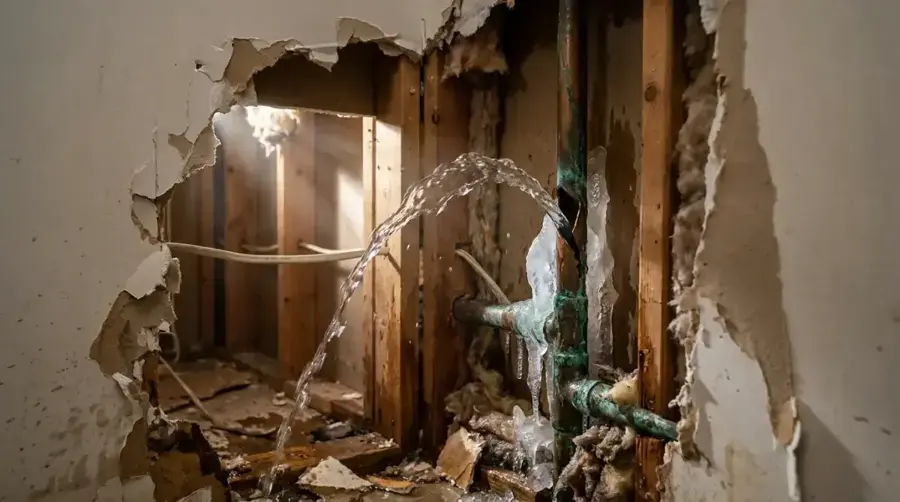
Lancaster grew around the cotton mill that Leroy Springs founded in 1895, so older blocks mix early 1900s frame houses with postwar brick ranches and newer subdivisions. The plumbing inside differs just as much, from galvanized supply pipe and cast iron drains in older houses to polybutylene in some 1980s and 1990s homes and CPVC and PEX in newer ones. This post covers how slow leaks show themselves, what to do first and how a hidden wet area is found and dried.
Key takeaways
- Older Lancaster blocks mix early 1900s frame houses, postwar brick ranches and newer subdivisions, and the pipes inside vary with the era.
- Galvanized supply pipe, cast iron drains and polybutylene in some 1980s and 1990s homes are the aging materials; CPVC and PEX are common in newer ones.
- A hidden leak shows as stains that return, a musty smell, soft or cupped floors, or a water meter that moves with everything off.
- Shut off the main water valve for an active leak, photograph the damage and call a plumber for the pipe and the restoration team for the water.
- Drying starts with finding every wet area using moisture readings, not just the visible stain.
What is inside older Lancaster walls
The mix of house ages in Lancaster means no single pipe material runs through every wall. The failure points differ with the era.
Galvanized supply pipe
Galvanized steel pipe rusts from the inside over time. The rust narrows the pipe, and thin spots or threaded joints can start to seep.
Rust also chokes the flow, so weak pressure at one faucet can be an early sign.
Cast iron drains
Cast iron drain pipe can corrode, crack or separate at joints. A weeping joint leaks wastewater into the wall, ceiling or crawl space below.
Plastic supply pipe, old and new
Some 1980s and 1990s homes have polybutylene supply pipe, a flexible plastic pipe known for failing at fittings. Newer homes use CPVC and PEX, which have their own weak points at joints.
Signs of a leak you cannot see
No single sign proves a leak, but two or three together deserve a closer look. In Lancaster's humid subtropical climate, a closed wall cavity that gets wet stays damp for a long time, which is why finding the source early matters.
What a homeowner notices
- A ceiling or wall stain that grows or returns after it dries
- A musty smell in a closet, a cabinet or a room above a crawl space
- Floors that feel soft, cup or lift near a bath or kitchen
- Paint or wallpaper that bubbles or peels without an obvious cause
- The sound of running water when every fixture is off
Where hidden leaks tend to sit
- Behind a tub or shower wall
- Under a kitchen or bath floor
- In a ceiling cavity below a bathroom
- Inside an exterior wall or a crawl space
Water spreading right now?
Shut off the main if it is safe. The restoration team extracts, dries to the IICRC S500 goal and documents every step, 24/7.
The meter check and the first steps
A leak that opens into a spray is burst pipe water damage, and the steps below apply at once. A small stain deserves attention too, since a patch of sealant does not stop water inside a wall.
A simple meter check
Turn off every fixture and appliance, including the ice maker, then read the water meter and look again after a pause. If the reading or the leak indicator moves, water is going somewhere.
A pencil mark around the edge of a stain, with the date beside it, shows whether the stain is growing.
First steps for an active leak
- Shut off the main water valve.
- Photograph the stain, the wall and the floor.
- Move belongings away from the wet area.
- Switch off power to the area if the leak is near outlets, fixtures or a ceiling light.
- Do not cut into a wall near wiring.
- Call a plumber for the pipe and the restoration team for the water.
How the restoration team finds the wet area
A stain shows where water ended up, not always where it started. The crew works from readings, not from the stain alone, and a ceiling leak water damage job often begins well away from the visible mark.
The visible stain is often the smallest part of the wet area. Framing, insulation and the back of the drywall can hold far more water than the surface shows.
- A moisture meter reads wall surfaces, baseboards and floors in a grid.
- A thermal camera highlights cool, wet areas behind a surface.
- Small openings in drywall let the crew check a cavity without cutting wide.
- The readings are mapped so the dry-out covers every wet area.
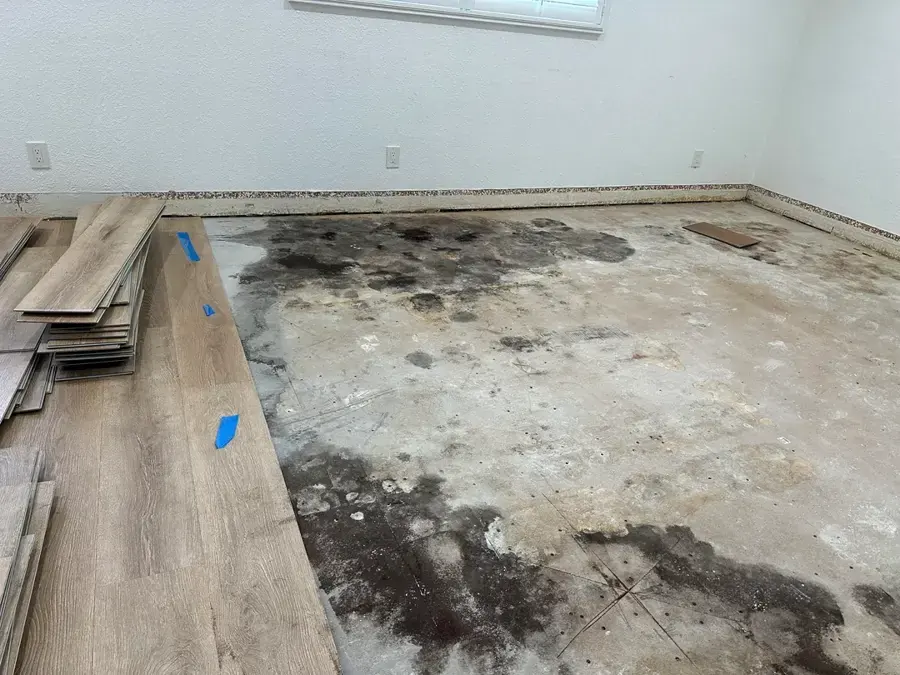
Opening, extracting and drying
Open and extract
- Wet drywall and insulation in the cavity are cut out.
- Water extraction removes standing water from the floor and the cavity.
- Flooring is lifted if water got beneath it.
Dry to a reading
Dehumidifiers and air movers dry the cavity and the framing. Structural drying ends when readings match dry materials elsewhere in the house.
When the leak was a drain
Water from a failed drain is wastewater, not clean supply water. It is Category 2 or 3 depending on what the drain carried, and the materials it touched are removed instead of dried.
A drain leak under a floor or in a crawl space can leave wastewater on soil and framing, so the area is cleaned and treated, not only dried.
Repair, replace or keep watching
The plumber decides whether a section of pipe can be repaired or a whole run should be replaced. The restoration team does not repair pipes.
It dries what the pipes soaked.
- Ask the plumber what the pipe is made of and where else it may be failing.
- Ask for a written note of where and why the pipe failed.
- Keep that note with the restoration records.
Records and coverage
Many policies treat a sudden burst differently from seepage over a long period, so the cause and the timing matter. The insurer can explain which applies.
- Dated photos of the stain, the opened wall and the pipe
- The plumber's note on the failed pipe
- Daily moisture readings from the drying team
- A list of what was removed, with rough ages
- Photos of the pencil-marked stain edge, with dates
Questions
How can a leak go unnoticed for months?
Water can run inside a wall or under a floor with no stain at first. The stain, smell or soft floor appears only after the materials have soaked up a good deal.
Is a musty smell always a hidden leak?
No. It can come from damp air or a closed room, but a smell that stays near a bath, a kitchen or a wet crawl space deserves moisture readings.
What is the difference between a slow leak and a burst pipe?
A burst pipe releases water in volume and is obvious. A slow leak releases a little over a long time and can wet framing and flooring before anyone notices, so more material may need to come out.
Does replacing old pipe stop the problem?
A plumber can say. Replacing a failing run removes that source, but the wet materials around it still need to be dried.
Will insurance cover a slow leak?
Policies often treat sudden bursts and long-term seepage differently. The insurer can explain which applies, and dated photos and readings support the file.
Can a restoration crew find the leak?
The crew finds the wet area and dries it. The plumber locates and repairs the failed pipe, and the two work in step.