Structural Drying and Dehumidification in Lancaster, SC
Surfaces dry fast and the structure does not. The drying team maps moisture, sizes air movers and LGR dehumidifiers to the loss and runs them until framing, subfloor and drywall read dry.
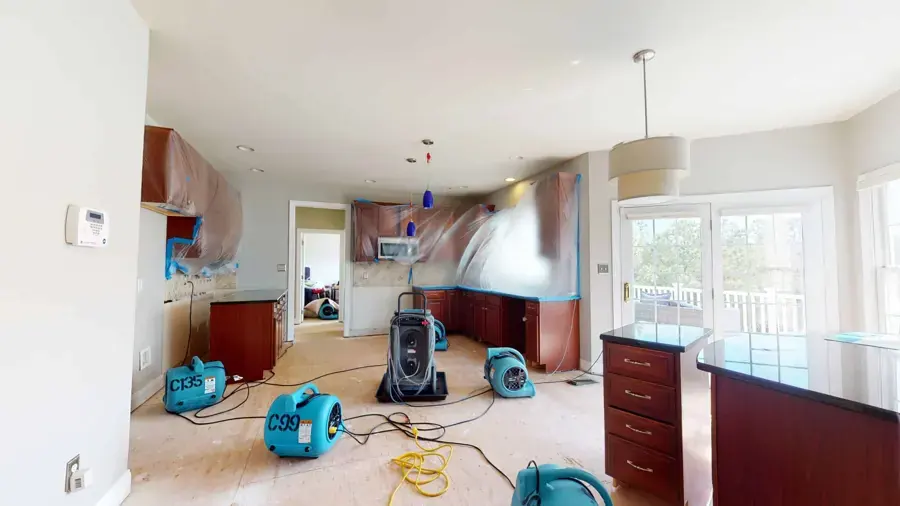
First steps for structural drying and dehumidification in Lancaster
Keep doors and windows closed so the drying team can control the air in the wet rooms.
Leave wet drywall and carpet in place until it is measured, unless it is falling or contaminated.
Call for a moisture map before any new flooring or paint goes on. Readings, not touch, decide when it is dry.
Wet framing in Lancaster? Get it measured, then dried.
(888) 532-8921 Book Lancaster drying readingsHow structural drying and dehumidification is handled in Lancaster
Structural drying is the part of a water job that decides whether problems show up months later. Carpet can feel dry while the pad, the subfloor and the bottom plate of the wall still hold water. The drying team measures those materials, not the surface.
Each job starts with a moisture map and a dry reference reading taken from the same material in an unaffected room. Equipment gets sized to the class of loss, and the drying team logs temperature, humidity and material readings every day until the wet areas match the reference.
What does structural drying and dehumidification cost in Lancaster, SC?
Structural drying in Lancaster, SC typically costs $1,200 to $5,000, depending on the class of loss, the number of rooms and how many days the air movers and dehumidifiers have to run.
Class 1 or 2, one area
- Moisture map and dry reference
- Air movers and an LGR dehumidifier
- Daily psychrometric logs
Class 3, several rooms
- More equipment and containment
- Walls and ceilings dried
- Crawl space dehumidifier
Class 4 or large loss
- Desiccant drying for dense materials
- Hardwood or plaster drying
- Extended monitoring
Ranges are typical, not a quote: the water category, square footage, material class and how fast drying started move the number most. Run the Lancaster water damage cost calculator for a closer range.
The structural drying and dehumidification process in Lancaster
Map and measure
The tech who does the walkthrough maps moisture and takes dry reference readings in unaffected rooms.
Size the equipment
The drying team sets air movers and LGR or desiccant dehumidifiers to the class of loss and the room's evaporation load.
Monitor daily
Temperature, humidity and material readings get logged every day, and equipment moves as areas dry.
Verify dry
Equipment comes out only when wet materials read within 2 to 4 points of the dry reference.
How structural drying works
Drying is a balance of airflow, dry air and heat. Too little of any one stalls the job.
- Air movers: push air across wet surfaces to speed evaporation.
- LGR dehumidifiers: pull the evaporated water out of the air so it does not soak back in.
- Desiccant dehumidifiers: dry dense materials and cool or very damp spaces, a Class 4 tool.
- Containment: plastic walls keep the drying zone small so equipment works on what is wet.
Dry to the touch is not dry
Daily readings and a dry reference show when the structure is actually dry.
Drying in humid Lancaster summers and crawl spaces
Carolina summer air holds a lot of moisture, so opening windows rarely helps a dry-out. The drying team closes up the work area and lets the dehumidifiers control the air. In crawl space houses, a dehumidifier often runs under the floor as well, because joists and subfloor dry from both sides.
- Class 1 and 2: carpet, pad and wall bottoms, often dry in three to five days.
- Class 3: water from above, soaked walls and ceilings, more equipment and time.
- Class 4: hardwood, plaster and concrete, slow-drying materials that may need desiccants.
Structural drying records for the claim
The psychrometric logs, the moisture map and the final dry readings show the adjuster that the structure was dried, not just aired out. Those records also tell the rebuild crew when it is safe to close walls and lay flooring. Coverage depends on your policy, so check with your own insurer.
Structural drying and dehumidification across Lancaster and Lancaster County
Lancaster Water Damage Restoration covers ZIP 29720, 29721, 29722 in Lancaster 24/7, from Downtown and the Main Street historic district to the Lancaster Mill area, Springdale, Elgin and Erwin Farm.
Nearby coverage reaches Van Wyck, Indian Land, Heath Springs, Kershaw, Fort Lawn, Great Falls, Pageland.
Every Lancaster neighborhood and ZIP covered ›Structural Drying and Dehumidification questions in Lancaster
What does structural drying mean?
It means drying the building materials themselves, like framing, subfloor and drywall, not just the surfaces. Readings confirm the materials are back to their normal moisture level.
Why can't the fans come out when the floor feels dry?
Wood and drywall hold water after the surface feels dry. Readings decide, so equipment stays until materials match the dry reference.
What is an LGR dehumidifier?
A low grain refrigerant dehumidifier pulls more water out of the air than a household unit, which keeps evaporation going in a closed drying area.
Should I open windows to help drying?
Usually not in Lancaster. Humid outdoor air slows drying, so the drying team keeps the work area closed and lets the dehumidifiers control the air.
How long does structural drying take?
A contained Class 1 loss usually dries in three to five days. Class 3 and 4 losses, crawl spaces and hardwood can take a week or more.
Is structural drying covered by insurance?
Drying after a covered water loss is usually part of the claim, and the daily logs support it. Coverage depends on your policy, so check with your own insurer.