Storm and Flash Flood Cleanup in Weddington, NC
Heavy rain and creek spill leave mud, silt and soaked drywall behind, so crews pump out, cut back what the water touched, sanitize and set drying equipment to readings.
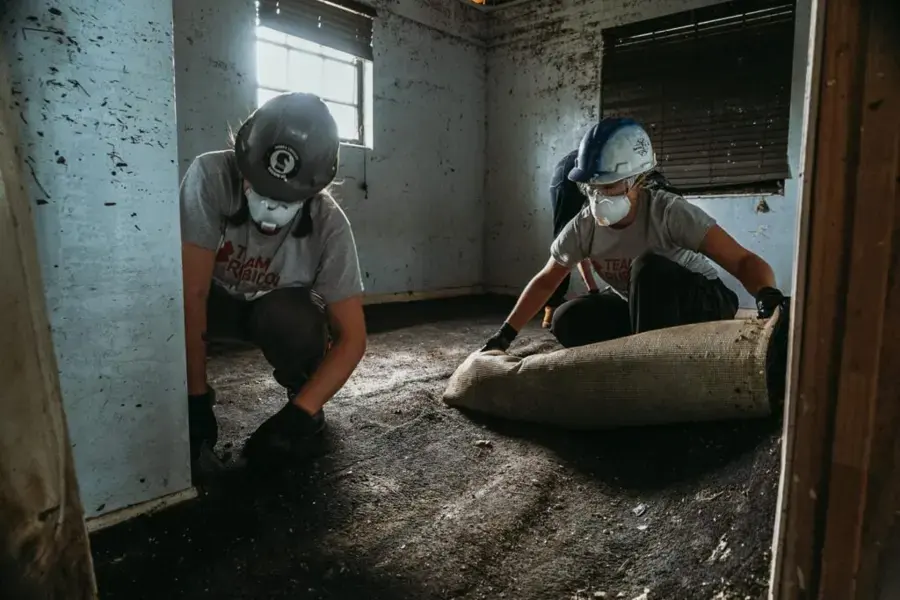
First steps for storm and flash flood cleanup in Weddington
Stay out of water that may touch outlets or appliances, and switch off power to the flooded area from a dry spot.
Photograph the high-water mark and the depth in each room before wet carpet, drywall and belongings are moved or discarded.
Call the crew to plan the pump-out, tear-out and drying order.
How storm and flash flood cleanup is handled in Weddington
Flood cleanup differs from a plain leak because the water arrives from outside carrying soil, silt and whatever it crossed. Weddington crews treat it as contaminated until proven otherwise and plan the removal, cleaning and drying as separate stages. That order keeps clean materials from being soaked a second time.
What does storm and flash flood cleanup cost in Weddington, NC?
Storm and flood cleanup in Weddington typically costs $3,000 to $6,000 for a garage or one room, $6,000 to $12,000 for several rooms, and $12,000 and up for a whole floor or crawl space and rooms.
One room or a garage
- Pump-out and mud shoveled out
- Flood cuts and antimicrobial wash
- Drying with daily readings
Several wet rooms
- Carpet, pad and insulation removed
- Crawl space drying where present
- Contents moved, cleaned, itemized
Whole floor, or crawl space and rooms
- Complete mud-out and tear-out
- Desiccant drying or added LGR units
- Scope itemized for the adjuster
Ranges are typical, not a quote: the water category, square footage, material class and how fast drying started move the number most. Run the water damage cost calculator for a closer range.
The storm and flash flood cleanup process in Weddington
Assess and shut down
Electrical hazards are checked, the water source is identified, and depth and category are recorded with photos.
Pump out and mud out
Water is pumped down, silt is shoveled and rinsed out, and contents are moved to a clean, dry holding area.
Cut, clean and treat
Wet drywall and insulation are cut out above the high-water mark, framing is cleaned and an antimicrobial goes on exposed surfaces.
Dry and document
LGR units and air movers dry what remains while daily readings and photos build the itemized scope for the adjuster.
Where flood risk sits around Weddington
In the Town's land use plan, floodplain is only a small portion of Weddington; the higher risk sits around creeks and streams and in pockets across the southern half. Six Mile Creek and Twelve Mile Creek are the main creeks, and wetlands cluster around Davis Mine Creek.
Hurricane Florence's rain on September 16, 2018 shows the scale: nearly 100 roads were underwater and closed countywide, according to the Union County emergency operations center, and creeks cut off homes.
Plan the flood cleanup
Tell dispatch how deep the water got, where it came from and which rooms are affected, and the crew sets the pump-out and tear-out order.
What the cleanup sequence covers
Flood jobs run in a set order so clean materials are not soaked twice.
- Pump-out and mud removal come first, with silt cleared down to the subfloor.
- Flood cuts above the high-water mark remove wet drywall and insulation.
- Antimicrobial treatment goes on exposed framing before any drying equipment runs.
Contents that can be cleaned are moved to a dry area and itemized so nothing is lost from the claim.
Flood maps, insurance and rebuilding
Weddington's flood ordinance adopts the FEMA Flood Insurance Study and the flood maps for Union County as its official reference. The Town belongs to the National Flood Insurance Program, and notices from Waxhaw and Monroe put the start of a 90-day public window on the preliminary Union County maps at September 17, 2025.
The Town also requires a floodplain development permit for any development in a floodplain, so rebuilding questions on a mapped property should go to the Town before work starts. For a wet home, water extraction and structural drying follow the mud-out.
When to treat a wet home as flooded
If water entered from outside, covered more than a small area or sat on carpet and pad, assume contamination and keep family members, pets and food away from the area until the crew has assessed it. Wet drywall, insulation and carpet that touched floodwater are usually removed, because drying cannot make them sanitary again.
Storm and flash flood cleanup across Weddington and nearby communities
Storm and flood crews cover ZIP 28104 and the Weddington area, including Weddington Glen, Woodford Chase, Highgate, Bromley, Hemby Place, Hadley Park and Aero Plantation, among others.
The same service nearby: storm and flash flood cleanup in Lancaster, Wesley Chapel, Marvin.
Water damage restoration in Weddington › Every town covered ›Storm and Flash Flood Cleanup questions in Weddington
Is floodwater always treated as contaminated?
Water that enters from outside is generally treated as Category 3 because it carries soil and runoff. The crew checks the site before deciding what is removed and what can be dried.
Which parts of Weddington have flood risk?
The Town's plan points to creeks, streams and pockets in the southern half of town. Whether a specific property sits in floodplain needs a look at the official maps, not a guess.
Does a lender care about floodplain status?
The Town notes that a property shown in floodplain may face higher flood risk, a lender flood insurance requirement or building limits, which is why map status is worth checking.
What gets thrown away after a flood?
Carpet, pad, insulation and drywall that touched floodwater usually go, along with porous contents. Hard surfaces and solid framing are cleaned, treated and dried instead of replaced.
How is drying handled after the mud-out?
Equipment is placed from the moisture map, and the crew logs readings each visit until framing and subfloor reach the dry reference.
Will the insurer want an itemized scope?
Adjusters generally ask what was removed, what was dried and why, so the crew records depth, photos and readings and prepares an itemized scope that follows the work as it happens.