Structural Drying and Dehumidification in Weddington, NC
After the water is out, the structure still holds moisture, so crews set LGR dehumidifiers and air movers to a written drying goal and log readings daily until walls and floors reach dry.
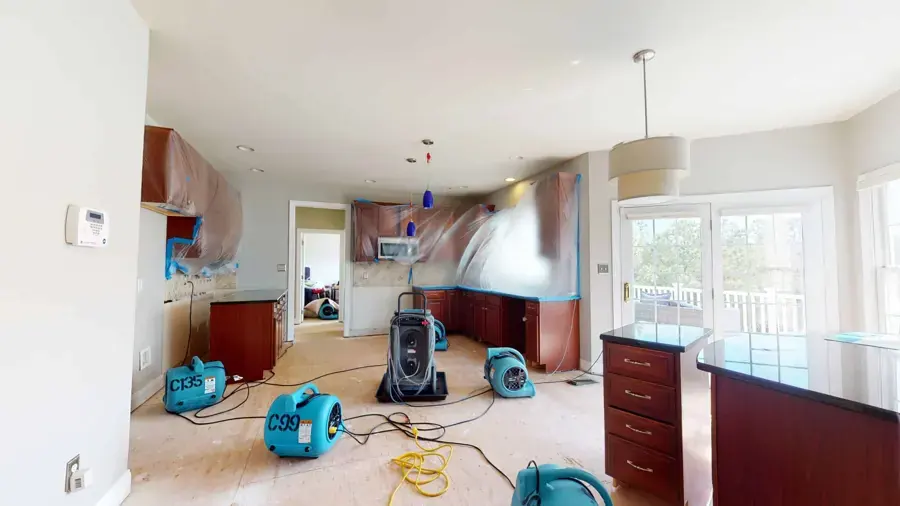
First steps for structural drying and dehumidification in Weddington
Keep the water source off and leave wet carpet, baseboards and drywall in place until the crew has measured them.
Close interior doors to wet rooms, avoid household fans, and keep pets and foot traffic away from wet floors.
Call the crew for a moisture map, then expect equipment to stay running and for readings to be taken each visit.
How structural drying and dehumidification is handled in Weddington
Extraction takes out the water you can see; structural drying removes the water you cannot. Walls, framing, subfloor and cabinet bases hold moisture long after the surface feels dry, so a Weddington crew measures first, dries to a written goal and proves the result with daily readings.
What does structural drying and dehumidification cost in Weddington, NC?
Structural drying in Weddington costs $1,200 to $2,500 for Class 1 or 2 areas, $2,500 to $5,000 for Class 3 in several rooms, and $5,000 and up for Class 4 or large losses.
Class 1 or 2, one area
- Moisture map and dry reference
- LGR unit with air movers
- Daily psychrometric logs
Class 3, several rooms
- More equipment and containment
- Walls and ceilings dried
- Crawl space dehumidifier added
Class 4 or large loss
- Desiccant drying for dense materials
- Hardwood or plaster drying
- Extended monitoring visits
Ranges are typical, not a quote: the water category, square footage, material class and how fast drying started move the number most. Run the water damage cost calculator for a closer range.
The structural drying and dehumidification process in Weddington
Measure and map
Meters and thermal imaging map the wet area and set a dry reference from unaffected materials in the same house.
Plan the equipment
The class of loss decides how many dehumidifiers and air movers are used, and where containment helps.
Run and adjust
Each visit the crew logs temperature, humidity and moisture content, then moves or adds equipment as readings change.
Confirm and remove
Equipment comes out only when affected materials match the dry reference, and the logs go to the owner.
How the S500 drying classes work
The IICRC S500 standard sorts losses by class, from Class 1 with little wet material to Class 4 with dense materials such as hardwood or plaster holding deep moisture. The class sets how much equipment is used and whether desiccant drying is added.
- Class 1 and Class 2 jobs cover limited wet areas and modest equipment.
- Class 3 means saturated ceilings, walls and insulation, which need more airflow and containment.
- Class 4 adds dense materials that need slower, specialty drying.
Set the drying plan
Tell dispatch what got wet and what was already pulled out, and the crew plans equipment, containment and daily readings.
What the equipment actually does
LGR dehumidifiers pull water from the air at low humidity, air movers push dry air across wet surfaces, and thermal imaging shows where moisture is hiding. Together they move water out of materials and into the air, where it is removed.
A typical setup uses several air movers per wet room and at least one dehumidifier per area, adjusted as readings change.
- Containment keeps drying air working on the wet area instead of the whole house.
- Injection and cavity drying reach wall bays without opening the whole wall.
- Desiccant units handle dense materials that refrigerant units cannot dry alone.
Why Weddington homes vary
The Census Bureau's survey counts about 4,583 housing units in Weddington, nearly all of them single-family homes. About 7 percent, roughly 326 homes, were built before 1980, and about 49 percent date from 2000 onward, so a drying crew meets older and newer construction.
When drying is finished
The job ends when readings in the affected materials match the dry reference taken from unaffected areas of the same house. Equipment is removed only then, and the daily logs and final readings go into the file for the adjuster. See water extraction for the step before drying and storm and flash flood cleanup for large events.
Structural drying and dehumidification across Weddington and nearby communities
Drying crews serve ZIP 28104 and the wider Weddington area, including Highgate, Bromley, Hemby Place, Williamsburg, Providence Place, Lake Forest Preserve and the Town Center, plus other subdivisions.
The same service nearby: structural drying and dehumidification in Lancaster, Wesley Chapel, Marvin.
Water damage restoration in Weddington › Every town covered ›Structural Drying and Dehumidification questions in Weddington
How long does structural drying take?
It depends on the class of loss, the materials and the weather, and readings decide when it ends. Small jobs can finish in a few days, while dense materials take longer.
Why does the equipment run day and night?
Drying works only while air keeps moving and humidity stays low, so equipment runs continuously until readings reach the dry reference. Stopping early lets moisture settle back into the structure.
What is the dry reference?
It is a set of readings taken from unaffected materials in the same house. Wet materials are dried until their readings match it, not to a number from a chart.
Can hardwood floors be dried instead of replaced?
Often, when drying starts early. Boards cup and buckle as water sits under them, so drying mats pull moisture out through the floor while meters track progress.
Why dry to readings instead of by feel?
Surfaces feel dry long before framing and subfloor are, and leftover moisture invites odors and mold. Meters show what a hand cannot, which is why the logs matter.
Will the insurer pay for the drying equipment?
Policies differ, but adjusters generally expect daily logs showing why equipment was needed and when it came out, and the crew keeps those with the itemized scope.