Structural Drying and Dehumidification in Marvin, NC
Structural drying brings framing, subfloor and drywall back to a dry reference with air movers and LGR dehumidifiers, and it is how a Marvin home is verified dry, not just dry to the touch.
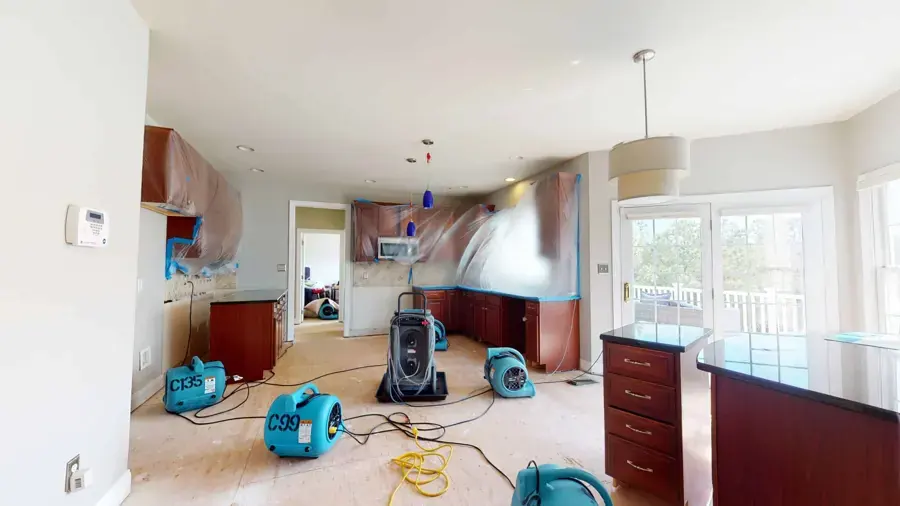
First steps for structural drying and dehumidification in Marvin
Stop any active leak and remove standing water first, because drying equipment works on moisture in materials, not on puddles.
Keep doors and windows closed in the drying zone so the dehumidifiers work on the wet air only.
Leave equipment running and untouched, and let the crew read the meters each day.
How structural drying and dehumidification is handled in Marvin
Wet drywall that feels dry can still be hiding moisture in the studs and subfloor behind it. Structural drying is the part of a water job that proves otherwise, using airflow, dehumidification and daily measurements until every material reaches the reference set on the first visit.
What does structural drying and dehumidification cost in Marvin, NC?
A Class 1 or 2 area runs $1,200 to $2,500, a Class 3 loss across several rooms moves to $2,500 to $5,000, and Class 4 or large losses begin at $5,000 and up.
Class 1 or 2, one area
- Moisture map and dry reference
- LGR unit and air movers
- Daily psychrometric logs
Class 3, several rooms
- Added equipment and containment
- Walls and ceilings dried
- Dehumidification below the floor
Class 4 or large loss
- Desiccant drying for dense materials
- Hardwood or plaster drying
- Extended monitoring
Ranges are typical, not a quote: the water category, square footage, material class and how fast drying started move the number most. Run the water damage cost calculator for a closer range.
The structural drying and dehumidification process in Marvin
Map and baseline
Meters and a thermal camera chart every wet material, and a dry reading from unaffected material sets the target.
Place equipment
Air movers and LGR dehumidifiers go where the map points, sized to the room volume and the class of loss.
Monitor daily
Temperature, humidity and moisture content are logged at the same spots, and equipment is adjusted to the numbers.
Verify and release
Equipment is removed only once every reading reaches the target, and the full record is handed over.
Who needs it in Marvin
Census Bureau survey estimates say 1,907 of Marvin's 1,917 homes are owner-occupied, about 82 percent were built in 2000 or later and the median value is $906,000. Those are houses owners protect, so a documented, verified dry result matters to owners and insurers alike.
- Any water loss that reaches framing, subfloor or insulation, not just carpet
- Hardwood, plaster and other dense materials that hold water for weeks if left alone
- Rooms where a smell or a stain returns after the first drying attempt
Prove the structure dry
A call about what was wet and for how long lets the crew size the dehumidifiers and air movers.
How the equipment works together
An LGR dehumidifier pulls water vapor out of the air, air movers sweep the wet surfaces so more moisture evaporates, and the balance between them is set from temperature and humidity readings instead of guesswork.
Drying classes set the plan: Class 1 and 2 losses involve limited materials, Class 3 means water came from above and soaked ceilings, walls and insulation, and Class 4 covers dense materials such as hardwood and plaster that need specialty drying.
How drying is proven
Each visit records temperature, relative humidity and moisture content for the same spots, and equipment comes out only when those numbers match the dry reference taken from unaffected material. The drying time estimator shows how the days add up.
- Readings logged at fixed points every day
- Equipment moved or removed as areas reach the reference
- Final report with the full drying record
Why the record matters
A completed log shows the insurer what was wet, how it was dried and when it reached the reference, and it gives the owner proof that the structure was handled to a recognized standard. Water extraction is the step that comes before it.
Structural drying and dehumidification across Marvin and nearby communities
Structural drying runs across ZIP 28173 in Marvin, from Firethorne Country Club and Innisbrooke at Firethorne to The Preserve at Marvin, Amber Meadows, Tullamore, Belle Grove and the Marvin Heritage District.
The same service nearby: structural drying and dehumidification in Lancaster, Weddington, Waxhaw.
Water damage restoration in Marvin › Every town covered ›Structural Drying and Dehumidification questions in Marvin
How long does structural drying take?
Most losses need several days, though the logs rather than the calendar decide, and dense materials like hardwood and plaster run longer.
Why are the machines so loud and so many?
Each LGR dehumidifier and air mover is sized to the volume and class of the loss, and too little equipment leaves moisture behind in the framing. The crew adds or removes units as readings change.
Can the air conditioner help dry a room?
Not as a substitute. Air conditioning cools but does not remove moisture at the rate an LGR dehumidifier does, so it can assist comfort while the equipment does the drying.
Does drying prevent damage later?
Reaching the dry reference removes the moisture that lets materials swell, warp or stay damp, which is why the verified log matters.
Is drying needed if the carpet is already gone?
Yes. Removing carpet and pad takes out the most obvious wet material, but the subfloor, framing and walls still hold moisture, and they stay damp until equipment and readings prove otherwise.
What does drying cost?
Structural drying runs from $1,200 to $5,000 and up, tied to the drying class, the rooms involved and how long equipment must stay. The cost calculator gives a starting number.