Structural Drying and Dehumidification in Wesley Chapel, NC
Equipment is sized to the drying class, placed from a moisture map and checked daily with psychrometric readings, so framing, subfloor and walls in Wesley Chapel homes reach a dry reference before anything leaves.
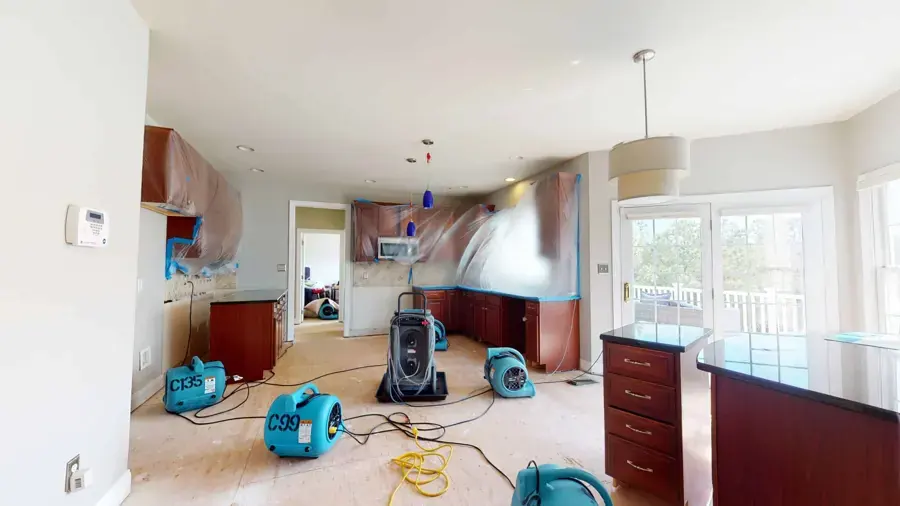
First steps for structural drying and dehumidification in Wesley Chapel
Keep thermostats at a normal setting and leave equipment running, since turning units off lets humidity climb and slows drying.
Keep doors and windows closed in the drying area, and keep people and pets away from cords and hoses.
Do not move air movers or unplug the dehumidifier, and call the crew if a reading, a noise or a smell changes.
Wet structure in Wesley Chapel? Call the crew to plan the drying.
(888) 532-8921 Plan a Wesley Chapel dry-outHow structural drying and dehumidification is handled in Wesley Chapel
Structural drying is what happens after the water is gone. Wet framing, subfloor, drywall and hardwood still hold moisture, and the job is to move it out in a controlled way and prove it with numbers instead of touch. Skipping this step is how moisture ends up trapped behind finished surfaces.
What does structural drying and dehumidification cost in Wesley Chapel, NC?
A Class 1 or 2 loss in one area costs $1,200 to $2,500, Class 3 across several rooms costs $2,500 to $5,000, and Class 4 or a large loss costs $5,000 and up.
Class 1 or 2, one area
- Moisture map and a dry reference
- Air movers beside an LGR dehumidifier
- Psychrometric logs every visit
Class 3, several rooms
- Extra equipment behind containment
- Walls and ceilings dried
- Crawl space dehumidifier added
Class 4 or a large loss
- Desiccant units for dense materials
- Hardwood or plaster dried slowly
- Longer monitoring with daily reports
Ranges are typical, not a quote: the water category, square footage, material class and how fast drying started move the number most. Run the water damage cost calculator for a closer range.
The structural drying and dehumidification process in Wesley Chapel
Classify and map
The technician sets the drying class from the materials involved and maps wet areas with a meter and thermal camera.
Set the equipment
Air movers, LGR dehumidifiers and any containment go in at positions chosen from the map and the room volume.
Monitor daily
Each visit logs temperature, humidity and material readings, then moves or adds equipment as the numbers change.
Confirm and remove
Equipment leaves only when every monitored spot matches the dry reference, and the final log goes into the file.
Homes that dry here
The Census Bureau's American Community Survey puts about 67 percent of Wesley Chapel's housing units at 2000 or later construction, and about 98 percent of occupied homes are owner-occupied.
Owners therefore usually deal with the carrier directly, so the drying records matter.
Plan a structural dry-out
Dispatch asks what was wet, for how long and which materials are involved before equipment is chosen.
Drying classes and equipment
The class sets the equipment. Class 1 and 2 losses involve little to moderate wet material and need air movers plus an LGR dehumidifier, Class 3 adds wet walls and ceilings, and Class 4 covers dense materials such as hardwood, plaster or concrete that need slower, deeper drying, sometimes with desiccant units.
- Air movers are set from the moisture map, not at random.
- The dehumidifier is sized for the room volume and the class.
- Containment or plastic keeps drying air where it is needed.
- Wet hardwood is dried with mats where the boards can be saved.
Reading the numbers
Each visit records air temperature, humidity and the moisture content of the framing, subfloor and drywall, and a dry reference taken from an unaffected area sets the goal. Equipment is adjusted or removed only when the readings say so.
- Temperature and humidity in the room and at the dehumidifier outlet.
- Moisture content in framing, subfloor and drywall at marked spots.
- The same marked spots every visit, so changes are real.
After a pipe or appliance loss, the water extraction page covers the step that comes first.
Documentation and hand-off
The daily log, photos of equipment placement and the final readings become the drying record. A carrier can compare that record with the scope, and the crew explains what each reading means when the owner asks.
Larger losses, such as a church hall, follow the commercial water damage phasing.
Structural drying and dehumidification across Wesley Chapel and nearby communities
Drying crews set up across the Wesley Chapel area, including Wesley Oaks, Stonegate, Quintessa and Addington Crossing, in whichever of the four overlapping ZIP codes a mailbox shows.
The same service nearby: structural drying and dehumidification in Lancaster, Weddington, Waxhaw.
Water damage restoration in Wesley Chapel › Every town covered ›Structural Drying and Dehumidification questions in Wesley Chapel
What is a drying class?
The class describes how much water and how many absorbent materials are involved. Class 1 is the least, Class 4 involves dense materials like hardwood or plaster, and the class decides the equipment.
Can a fan alone dry a wet house?
Fans move air, but only a dehumidifier removes the moisture from it. Without that, humidity climbs and the water just moves from the structure back into the room.
Why do dehumidifiers run so long?
Wet framing and subfloor release moisture slowly, so drying proceeds over several days. The readings, not a calendar, tell the crew when the structure has reached its dry goal.
Can the equipment run overnight?
Yes, and it must, because drying only progresses while the equipment operates. The crew explains placement and cords so nothing becomes a trip hazard.
Does drying cost more than extraction?
Often yes, because equipment days and monitoring visits add up. A Class 1 or 2 area costs $1,200 to $2,500, and larger or denser jobs cost more.
Will the crew show the readings to the owner?
Yes. The log lists temperature, humidity and material readings by visit, and the technician walks through what each number means so the owner can see progress.