Structural Drying in Rock Hill, SC
After a large loss, drying equipment is placed from a moisture map, adjusted at every visit and removed only when framing, subfloor and walls read dry, so Rock Hill repairs start on sound materials.
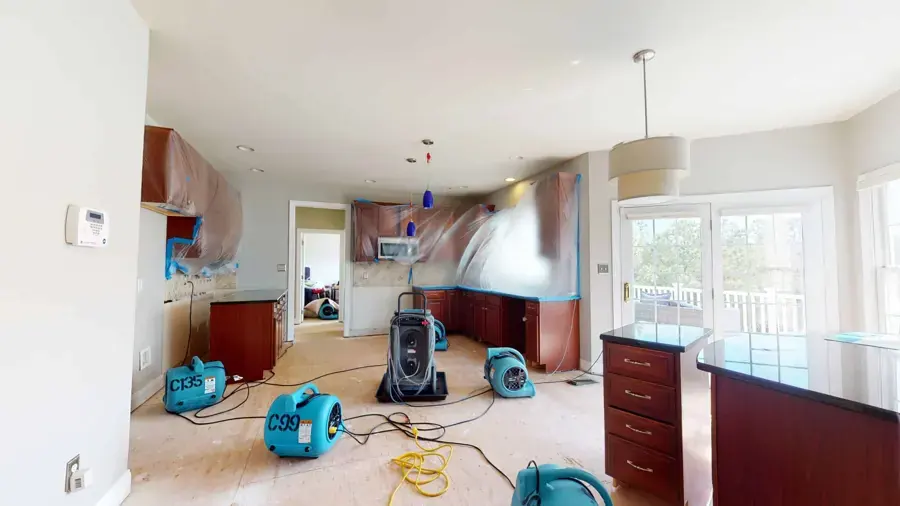
First steps for structural drying and dehumidification in Rock Hill
Stop the source and remove standing water first, since equipment cannot dry a floor that is still flooded.
Keep doors and windows closed and the thermostat steady while equipment runs, so the dehumidifiers can work.
Leave the equipment in place until the crew confirms readings, and do not unplug air movers because of the noise.
How structural drying and dehumidification is handled in Rock Hill
Structural drying is the technical core of most water jobs. Extraction removes the liquid, but wet framing, subfloor, drywall and hardwood hold moisture that only controlled air, heat and dehumidification can pull out. The goal is a measured dry structure, not a dry look.
What does structural drying and dehumidification cost in Rock Hill, SC?
A Class 1 or 2 loss dries for $1,200 to $2,500 in Rock Hill, a Class 3 loss for $2,500 to $5,000, and Class 4 or large losses start at $5,000 and up.
Limited area, Class 1 or 2
- Map and dry reference set
- Air movers, one LGR dehumidifier
- Logs recorded each visit
Several rooms, Class 3
- More equipment, containment
- Walls and ceilings dried
- Dehumidifier capacity added
Class 4 or large loss
- Desiccant for dense materials
- Hardwood or plaster drying
- Extended monitoring
Ranges are typical, not a quote: the water category, square footage, material class and how fast drying started move the number most. Run the water damage cost calculator for a closer range.
The structural drying and dehumidification process in Rock Hill
Classify and map
The crew identifies the class and category of the loss, then maps moisture in each affected material.
Place the equipment
Air movers, LGR dehumidifiers and any desiccant units are placed from a calculated plan, with containment where needed.
Monitor and adjust
Temperature, humidity and material readings are logged each visit, and equipment is moved or changed as the numbers shift.
Confirm dry
Equipment comes out when readings match the dry reference, and the logs are handed over with the final report.
Classes of water and why they matter
IICRC S500 sorts losses into four classes by how much moisture the materials can hold and release. Class 1 and 2 losses involve limited areas or wet carpet and pad, Class 3 involves water from above that has soaked ceilings, walls and insulation, and Class 4 covers dense materials such as hardwood and plaster that hold water deeply.
- Class 1 and 2: air movers and a dehumidifier sized to the room, with carpet lifted or pad removed
- Class 3: more equipment, opened ceilings and walls, and containment so moisture does not drift
- Class 4: desiccant units, drying mats or injection systems for hardwood, plaster and other dense materials
The class is set on the first visit and revisited when the readings change, because a loss that looks like Class 2 can behave like Class 3 once the walls are opened.
Plan the drying
Describe what was wet and for how long, and the crew will set the class, the equipment and the monitoring plan.
Building age and the drying plan
About 37 percent of Rock Hill homes (12,953) were built before 1980, about 20 percent (6,958) from 1980 to 1999, and about 43 percent (15,024) in 2000 or later. Buildings of different ages use different framing, flooring and finishes, so the plan comes from the meter readings rather than an assumption about the date.
Monitoring until the structure is dry
Each visit records temperature, relative humidity and grains of moisture in the air, plus meter readings on drywall, framing and subfloor. Equipment is moved, added or removed based on those numbers, and a dry reference taken in an unaffected area sets the target.
The daily log is also the proof the adjuster needs. For the first stage of a loss, see water extraction, and for creek or storm water, see storm and flood cleanup.
Structural drying and dehumidification across Rock Hill and nearby communities
Drying crews work across Rock Hill, ZIP codes 29730 and 29732, including Old Town, Oakdale, Ebenezer, Newport, Boyd Hill and Riverwalk, with daily visits until the structure reads dry.
The same service nearby: structural drying and dehumidification in Lancaster, Marvin, Waxhaw.
Water damage restoration in Rock Hill › Every town covered ›Structural Drying and Dehumidification questions in Rock Hill
Why does drying take so many visits?
Water bound in wood, drywall and subfloor leaves slowly, and rushing it can trap moisture, so readings drive each visit and the equipment stays until the numbers match.
What is a dry reference?
It is a reading taken from the same material in an unaffected area, which becomes the target the wet materials must reach before equipment is removed.
Do older and newer Rock Hill homes dry differently?
They can. Rock Hill's median home was built in 1995, with about 37 percent of homes (12,953) built before 1980, and the plan follows the materials the meter finds wet.
Can equipment be turned off at night?
It should stay on. Dehumidifiers and air movers only work while running, and a shutdown lets wet materials reabsorb moisture, which extends the job.
Does drying stop microbial growth?
Drying to the dry reference is the main protection against it, though a loss that sat wet or involved sewage needs cleaning as well.
Which loss needs desiccant drying?
Class 4 losses in dense materials such as hardwood or plaster often need desiccant units or drying mats, and those losses begin at $5,000 and up.